Phone:
(413) 214-6541
Location:
15 Agawam Ave West Springfield, MA 01089
Mon - Fri:
8.00am - 7.00pm
Parent Website:
sterlinganalytical.com

- Home
- About Us
- Tests & Services
Catalyst Analysis Services
- Catalyst Impurity Testing
- Spent Catalyst Analysis
- Spent Catalyst Precious Metal Recovery Assay
- Precious Metal Assay Lab
- FCC Catalyst Analysis / E-Cat Metals Testing
- Pd/C Catalyst Metal Loading Testing
- Platinum Reforming Catalyst Testing
- Catalyst Poisoning & Contamination Testing
- Catalyst Support & Adsorbent Testing
- Contact Us
- Sample Delivery Instructions
Bauxite & Alumina Analysis
Related Posts
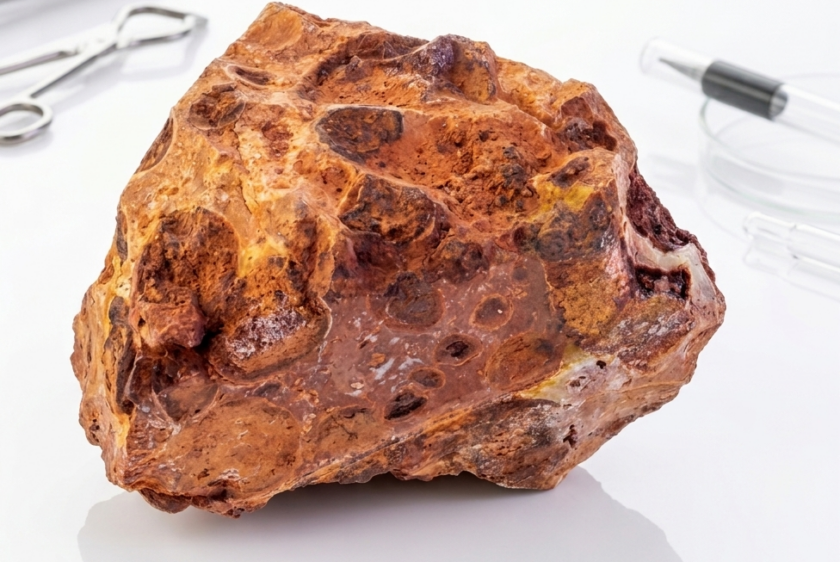
Sterling Analytical provides bauxite and alumina analysis, quantifying available alumina, reactive silica, and the iron, titanium, and gangue elements that determine bauxite’s suitability for Bayer process refining. Our ICP-OES testing serves bauxite mining operators, alumina refiners, and ore traders who need data built around how bauxite actually behaves in processing — not just its total chemical composition.
Bauxite contains aluminum primarily as hydrated alumina minerals (gibbsite, boehmite, or diaspore depending on deposit), extracted commercially through the Bayer process: bauxite is digested in hot caustic soda solution, dissolving the alumina into a sodium aluminate liquor that’s later precipitated and calcined to produce alumina, the feedstock for aluminum smelting. Total alumina content is a starting point for evaluating a bauxite deposit, but it isn’t the number that determines processability or economics — that distinction belongs to two more specific, Bayer-process-relevant parameters: available alumina and reactive silica.
Available Alumina vs. Total Alumina: Why the Distinction Matters
This is the single most important concept in bauxite assay, and it’s easy to miss if you’re thinking about alumina content the way you’d think about metal grade in a typical ore.
Total alumina includes all aluminum oxide present in the bauxite, regardless of mineralogical form. Available alumina (AA) is a narrower, more commercially meaningful figure: it represents the proportion of that alumina present in a form the Bayer process can actually extract under realistic refining conditions. Gibbsite-form alumina extracts efficiently at relatively low Bayer process temperatures (roughly 100–170°C), with extraction yields commonly exceeding 90% when silica-related impurities are properly managed. Some alumina, however, may be locked in forms that don’t dissolve efficiently in the caustic liquor under standard process conditions, and this fraction doesn’t count toward available alumina even though it shows up in a total alumina figure.
The practical consequence: two bauxite samples with identical total alumina content can represent meaningfully different commercial value if their available alumina differs, because available alumina is what an actual refinery can recover, not just what the rock contains on paper.
Reactive Silica: The Parameter That Actually Drives Bayer Process Cost
If available alumina determines how much alumina a bauxite can yield, reactive silica determines how expensive it is to get there — and this is the parameter that most directly separates economically viable bauxite from material that’s effectively unprocessable through standard Bayer refining.
Reactive silica (RS) refers specifically to the silica fraction that dissolves in the Bayer process’s caustic liquor, primarily sourced from clay minerals like kaolinite, as opposed to silica present as quartz, which is largely unreactive under standard process conditions and passes through largely unaffected. This distinction matters enormously: when reactive silica dissolves into the caustic liquor, it precipitates back out as a sodium aluminosilicate compound — consuming caustic soda in the process and representing a direct, ongoing operating cost, not a one-time quality deduction. Commercial Bayer process operation is generally confined to bauxite containing below roughly 5–6% reactive silica by weight; bauxite above that threshold becomes uneconomical to process through standard Bayer refining because of the caustic soda losses involved, regardless of how attractive its alumina content might otherwise look.
This is why reactive silica, specifically — not total silica — is the figure that actually matters for Bayer process economics, and why an assay reporting only total silica can be genuinely misleading about a bauxite deposit’s real commercial viability.
Matrix & Digestion
Bauxite requires digestion capable of fully dissolving hydrated alumina minerals alongside associated iron oxide, titanium oxide, and clay/silicate gangue phases.
Sterling Analytical’s approach:
- Multi-acid digestion or fusion-based preparation (lithium metaborate fusion is commonly used for bauxite specifically, given its effectiveness on refractory aluminosilicate phases)
- Method validation suited to complete dissolution across gibbsite, boehmite, and diaspore mineral forms, since these alumina minerals have different solubility characteristics requiring digestion conditions matched to the specific deposit mineralogy
- Specific attention to silica speciation considerations relevant to distinguishing reactive from total silica content, where this distinction is required for Bayer process suitability assessment
What We Test For: Iron Ore
- Total Alumina (Al2O3) : Starting reference figure for deposit characterization
- Available Alumina (AA) : The actual Bayer-process-extractable alumina fraction, the real commercial value driver
- Reactive Silica (RS): Caustic-soda-consuming silica fraction, the primary cost driver in Bayer process economics
- Total Silica (SiO2) : Reference figure; less commercially meaningful alone than reactive silica specifically
- Iron Oxide (Fe2O3) : Largely inert in Bayer processing, reports to red mud residue rather than driving cost directly.
- Titanium Dioxide (TiO2) : Largely inert in Bayer processing, similar to iron oxide.
Iron and titanium oxides deserve a specific note: unlike reactive silica, these compounds are generally insoluble in the Bayer caustic solution and have comparatively little direct effect on alumina extraction efficiency — they largely report to red mud, the substantial solid waste stream generated during Bayer processing (commonly 1 to 1.5 tons of red mud per ton of alumina produced), rather than driving processing cost the way reactive silica does.
Dealing with High-Silica Bauxite: Beneficiation as an Economic Lever
Not every bauxite deposit naturally falls below the reactive silica threshold that makes standard Bayer processing economical, and understanding the options for borderline or high-silica material adds useful context to interpreting an assay result.
Selective grinding and flotation are two beneficiation approaches that have shown real effectiveness at reducing reactive silica ahead of refining, by preferentially separating kaolinite (the main reactive silica source) from gibbsite (the alumina-bearing mineral) before the material ever reaches the Bayer circuit. Published beneficiation research has demonstrated alumina-to-silica ratio improvements of roughly 4:1 up to 7:1 or higher through cyclic desilication approaches, and flotation trials have achieved comparable or larger improvements — in some published work, raising the alumina-to-silica ratio from under 7:1 in flotation feed to over 11:1 in the concentrate, while still recovering the large majority of available alumina in the process.
This matters for how a high-reactive-silica assay result should be interpreted: it isn’t necessarily a dead end for a deposit’s commercial viability, but rather a signal that beneficiation investment may be needed to bring the material within economically processable range — a different conclusion than simply writing off the resource, and one that depends on having an accurate reactive silica baseline to evaluate beneficiation performance against.
Iron ore commercial value depends on physical form and mineralogical type as well as chemical composition, which is worth understanding even though this page focuses on the chemical assay itself.
Common Quality and Commercial Issues We Identify
- Available alumina meaningfully lower than total alumina would suggest, indicating a portion of alumina locked in non-extractable mineral forms
- Reactive silica approaching or exceeding the 5–6% threshold where standard Bayer processing becomes uneconomical
- Discrepancies between total silica and reactive silica results, relevant for accurately assessing true processing cost rather than relying on total silica alone
- Alumina-to-silica ratio trends across a deposit, useful for resource planning and blending strategy
- Iron and titanium content relevant to red mud volume forecasting and disposal planning, even though these elements don't drive extraction cost directly
Who Uses This Service
- Bauxite mining operators characterizing deposit quality for both resource economics and customer specification compliance, where available alumina and reactive silica — not total alumina alone — determine real commercial value.
- Alumina refiners screening incoming bauxite feedstock to forecast caustic soda consumption, processing economics, and expected alumina yield before committing material to the Bayer circuit.
- Ore traders requiring independent, defensible assay data on available alumina and reactive silica specifically, since these Bayer-process-relevant parameters are what actually determine transaction value.
- Junior mining and exploration companies characterizing deposit samples during resource development, where understanding the available alumina and reactive silica profile is essential for assessing project economics realistically.
- Process engineers evaluating beneficiation options (such as selective grinding or flotation) aimed at reducing reactive silica content ahead of refining, using assay trends to assess beneficiation effectiveness.
Sample Quantity & Handling
Required sample size: 50–100 grams of representative bauxite ore or processed alumina.
Packaging guidelines:
- Use sealed, clean containers appropriate for ore and mineral material
- Ensure the sample is genuinely representative — bauxite deposits can show real variability in both total and reactive silica content across a single resource
- Clearly label source, deposit, and dominant alumina mineral form (gibbsite, boehmite, diaspore) where known, since this affects expected Bayer process behavior and interpretation context
Turnaround Time & Pricing
Standard turnaround: 3–5 business days Rush service: 24–48 hours available
Pricing starts from $150 per sample, depending on element panel scope and whether reactive silica determination (as distinct from total silica) is required.
What You Receive
Clients receive a detailed Certificate of Analysis (COA) suitable for resource evaluation, processing economics assessment, and commercial transactions.
Your COA includes:
- Total and available alumina (Al2O3)
- Total and reactive silica (SiO2) where scoped
- Iron oxide, titanium oxide, and additional trace element panel
- Method references and digestion notes
- Reporting limits and analytical qualifiers
- Batch-level quality control summary
All results are supported by CRM-traceable calibration, with duplicates and matrix spikes performed on each analytical batch.
Methods & Standards
Sterling Analytical applies established methods adapted for bauxite and alumina materials:
- Multi-acid digestion or lithium metaborate fusion suited to bauxite mineralogy
- ICP-OES elemental analysis (SW-846 6010 framework)
- Reactive silica determination methodology distinct from total silica reporting, where scoped
- Calibration using certified reference materials (CRMs)
Related Services
Explore related services:
- Iron Ore & Manganese Ore Analysis
- Spodumene Concentrate Testing
- Catalyst Support & Adsorbent Testing
- Rare Earth Concentrate & Total REE Analysis
- Copper Concentrate Assay
Request a Quote
Ready to get started with bauxite or alumina analysis?
Submit your sample details to receive a fast quote and recommended analytical scope.
Frequently Asked Questions
It's used to determine available alumina and reactive silica, the two parameters that most directly determine Bayer process economics and bauxite commercial value, alongside total composition and trace elements like iron and titanium oxide.
Total alumina includes all aluminum oxide present regardless of mineral form. Available alumina is the fraction the Bayer process can actually extract under standard refining conditions, which is the commercially meaningful figure since it reflects real recoverable value.
Total silica includes all silicon dioxide present. Reactive silica is specifically the fraction (mainly from clay minerals like kaolinite) that dissolves in the Bayer process caustic liquor and consumes caustic soda as an ongoing operating cost, as opposed to quartz-form silica which is largely unreactive.
Above roughly 5-6% reactive silica, caustic soda consumption from the silica-precipitation reaction becomes high enough that standard Bayer process refining is no longer economically viable, regardless of the bauxite's alumina content.
Iron and titanium oxides are largely insoluble in Bayer caustic solution and report mostly to red mud waste residue rather than reacting and consuming process reagents, unlike reactive silica.
Not necessarily. Beneficiation methods like selective grinding and flotation can reduce reactive silica by separating kaolinite from gibbsite ahead of refining, with published research showing meaningful alumina-to-silica ratio improvements. A high reactive silica result may signal a need for beneficiation investment rather than ruling out the resource entirely.
50–100 grams of representative bauxite ore or processed alumina.
Standard turnaround is 3–5 business days, with 24–48 hour rush service available.
===========
===========
Quick Contact
If you have any questions or need help, feel free to contact with our team.
Send Us Email:
Call Us Today: