Phone:
(413) 214-6541
Location:
15 Agawam Ave West Springfield, MA 01089
Mon - Fri:
8.00am - 7.00pm
Parent Website:
sterlinganalytical.com
- Home
- About Us
- Tests & Services
Catalyst Analysis Services
- Catalyst Impurity Testing
- Spent Catalyst Analysis
- Spent Catalyst Precious Metal Recovery Assay
- Precious Metal Assay Lab
- FCC Catalyst Analysis / E-Cat Metals Testing
- Pd/C Catalyst Metal Loading Testing
- Platinum Reforming Catalyst Testing
- Catalyst Poisoning & Contamination Testing
- Catalyst Support & Adsorbent Testing
- Contact Us
- Sample Delivery Instructions
Lithium Hydroxide Purity Testing
Related Posts
Sterling Analytical provides lithium hydroxide purity testing, combining direct lithium assay with low-level impurity profiling by ICP-OES, built around the specific analytical challenges lithium hydroxide presents that lithium carbonate doesn’t. As high-nickel NMC and NCA cathode chemistries have become the dominant route to higher energy density in EV batteries, lithium hydroxide monohydrate (LiOH·H2O) has become the preferred lithium precursor for much of that production — which has pushed purity specifications and testing rigor higher across the supply chain in recent years.
Battery-grade lithium hydroxide monohydrate is typically specified at a minimum of 99.3 to 99.5% purity, but that headline number tells only part of the story. The same way two batches of lithium carbonate can both pass a purity check while differing meaningfully in specific trace elements, two LiOH·H2O lots can both clear a 99.3% threshold while carrying very different sodium, sulfate, or transition metal profiles — differences that matter a great deal once that material becomes part of a cathode precursor.
Our laboratory supports lithium hydroxide producers, cathode material manufacturers, and battery materials buyers who need both an accurate assay and a complete impurity picture, not just a single pass/fail number.
Matrix & Digestion
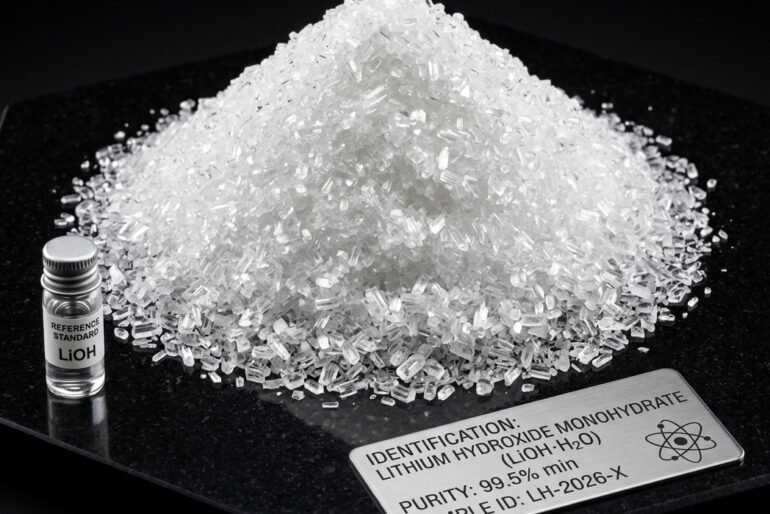
Lithium hydroxide monohydrate is hygroscopic — it actively absorbs moisture from the air — and dissolves in water with a notable heat release. Both properties matter for accurate testing in ways that are easy to overlook if you’re used to handling less reactive materials. A sample exposed to ambient humidity during storage, weighing, or handling can pick up water weight that skews assay results before digestion even begins, and the exothermic dissolution reaction needs to be managed carefully to avoid loss or splatter, similar in spirit to (though chemically different from) the CO2 effervescence concern with lithium carbonate.
There’s a second, less obvious challenge specific to high-purity lithium salts generally and lithium hydroxide in particular: the very high lithium concentration in the sample matrix can interfere with accurate measurement of certain trace elements during ICP-OES analysis. Sodium and potassium, both easily ionized elements, are particularly susceptible to this kind of matrix interference, which can produce false-positive or skewed results if the analytical method isn’t specifically tuned to manage it. Since sodium is one of the most closely watched impurities in battery-grade lithium hydroxide — even modest sodium contamination is associated with reduced battery life and safety risk — getting this measurement right isn’t optional.
Sterling Analytical’s preparation and analytical approach accounts for both challenges:
- Controlled dissolution to manage the exothermic reaction and prevent sample loss
- Handling procedures designed to minimize moisture pickup during sample preparation, protecting assay accuracy
- Matrix-matched calibration and instrument conditions selected to manage high-lithium matrix interference on easily ionized elements like sodium and potassium
- Clean labware and contamination control appropriate to low-ppm impurity targets
Why the Historically Tested Element List May Not Be Enough Anymore
For years, lithium salt purity in this industry was effectively defined by a relatively short, historically standard element list — aluminum, calcium, chromium, copper, iron, potassium, magnesium, manganese, sodium, lead, and zinc. A sample passing purity testing against that list at 99.9%+ purity was considered clean by industry standards for a long time.
The purity bar has moved substantially in recent years, though, with leading battery manufacturers now pushing toward 99.95–99.99% purity requirements as demand for longer-lived, higher-performance batteries increases. This shift matters analytically, not just commercially: published comparison testing has shown that lithium salt samples certified in the high-99.9% range using the traditional element list can fail to meet the same purity threshold once a broader element panel is applied — the headline purity number looked fine using the old reference list, but a wider trace element scan told a different story. This is a genuine, documented gap, not a hypothetical one, and it’s part of why we recommend confirming exactly which elements matter for your specific application and customer specification, rather than assuming a traditional short panel is automatically sufficient going forward.
Elements & Typical Reporting Limits
Our lithium hydroxide purity testing reports lithium assay alongside an impurity panel built around both traditional industry-standard elements and the broader trace element list increasingly required by high-purity battery-grade specifications.
- Lithium (Li) : Direct assay, calculated LiOH·H2O purity (%)
- Alkali / alkaline earth metals (Na, K, Ca, Mg) : ~1–10 ppm
- Transition metals (Fe, etc.) : ~1–5 ppm
- Other trace elements (Al, Zn, Pb, B, Cd) : ~1–10 ppm
- Sulfate / sulfur and chloride : Available on request
Sodium is reported with particular attention given its association with reduced battery life and explosion risk at elevated levels even in otherwise high-purity material. Additional elements can be added depending on your customer specification or cathode chemistry requirements.
Battery-Grade Context: Why Lithium Hydroxide Purity Matters More for High-Nickel Cathodes
Lithium hydroxide has become the preferred lithium source for high-nickel NMC and NCA cathode production specifically because it enables lower-temperature calcination than lithium carbonate, which helps preserve the structural integrity of nickel-rich cathode materials during synthesis. This is a real chemical advantage, but it also means LiOH purity issues propagate directly into cathode material quality in a way that’s harder to correct downstream than with some other precursor impurities.
Trace impurities introduced at the lithium hydroxide stage — whether from the original brine or ore source, the conversion process, or handling and storage — can carry through into the finished cathode material and affect electrochemical performance, cycle life, or safety characteristics. This is part of why impurity testing at the lithium hydroxide stage is treated as a meaningful checkpoint in the battery materials supply chain, not just a formality before shipment.
For ultra-trace requirements tied to the tightest battery-grade specifications, ICP-MS analysis extends detection well below what ICP-OES can reliably resolve (available via partner or future capability) — useful when a specific element needs to be confirmed at sub-ppm levels beyond standard ICP-OES sensitivity.
The Carbonate Self-Contamination Problem Specific to Lithium Hydroxide
There’s an impurity issue that’s specific to lithium hydroxide and doesn’t have a real equivalent in lithium carbonate testing: LiOH reacts readily with atmospheric CO2 to form lithium carbonate as a surface and bulk contaminant, essentially converting a portion of the material into the very compound it’s meant to be distinct from. This isn’t a minor effect — lithium hydroxide’s affinity for CO2 is strong enough that it’s used industrially as a CO2 scrubbing material in submarines and spacecraft life-support systems, which gives a sense of just how readily this reaction proceeds under normal atmospheric exposure.
For testing purposes, this means carbonate content is itself a meaningful quality parameter for lithium hydroxide, not an incidental impurity. Published comparison testing has shown a clear, measurable difference between LiOH samples stored covered (protected from CO2 exposure) versus uncovered over time, with uncovered samples showing a clear increase in carbonate content — and this carbonate buildup can begin during something as simple as extended sample handling before testing, not just during long-term storage. Technical-grade LiOH·H2O can commonly carry over 1% Li2CO3 as an impurity from manufacture and handling, and that carbonate impurity carries real downstream consequences: when used as a cathode precursor, residual carbonate can become trapped in the finished cathode material during high-temperature processing, where it resists decomposition and can compromise structural stability in nickel-rich formulations.
This is part of why minimizing air exposure during sample handling, covered above, isn’t just a generic best practice — for lithium hydroxide specifically, it’s protecting against the formation of a contaminant the material will otherwise generate on its own.
Who Uses This Service
- Lithium hydroxide producers confirming finished LiOH·H2O product meets battery-grade specification before shipment, across both traditional and expanded element panels.
- Cathode material manufacturers screening incoming lithium hydroxide supply, particularly for high-nickel NMC and NCA production where precursor purity directly affects cathode quality.
- Battery materials buyers and procurement teams qualifying new lithium hydroxide suppliers or comparing multiple sources against a consistent, independent testing standard.
- Process engineers monitoring lithium hydroxide purification or conversion processes (such as membrane electrodialysis routes from brine or spodumene-derived lithium) for consistency and impurity removal performance over time.
- Battery cell and pack manufacturers with closed-loop quality programs tracking precursor material quality as part of broader battery safety and performance assurance.
Sample Quantity & Packaging
Required sample size: 2–10 grams of lithium hydroxide monohydrate.
Packaging guidelines:
- Use clean, sealed HDPE or polypropylene containers with a tight, moisture-resistant seal — this matters more for LiOH·H2O than for less hygroscopic materials
- Avoid prolonged exposure to ambient air during sampling and packaging
- Avoid contamination from glass or metal tools
- Clearly label grade and lot number
Given the hygroscopic nature of this material, minimizing the time between opening a container and sealing the test sample helps protect assay accuracy.
Turnaround Time & Pricing
Standard turnaround: 2–4 business days Rush service: 24–48 hours available
Lithium hydroxide purity testing starts from $100–$150 per sample, depending on impurity panel scope and reporting requirements.
What You Receive
Clients receive a Certificate of Analysis (COA) suitable for process control, supplier qualification, and technical evaluation.
Your COA includes:
- Lithium concentration and calculated Li2CO3 purity (%)
- Impurity profile (ppm)
- Method references and preparation notes
- Reporting limits and analytical qualifiers
- Lot-based quality control summary
All results are supported by CRM-traceable calibration, with duplicates and matrix spikes performed on each analytical batch.
Methods & Standards
Sterling Analytical applies established methods adapted for lithium hydroxide:
- ICP-OES elemental analysis (SW-846 6010 framework)
- Controlled dissolution accounting for exothermic reaction and hygroscopicity
- Matrix interference management for easily ionized elements (Na, K) in high-lithium matrices
- Calibration using certified reference materials (CRMs)
Element panels can be scoped to traditional industry-standard lists or expanded to reflect tightening battery-grade purity requirements — we can advise on appropriate scope based on your application.
Related Services
Explore related services:
- Lithium Carbonate Purity Testing
- Battery Grade Lithium Chloride Testing
- Nickel, Cobalt & Manganese Sulfate Analysis
- Spodumene Concentrate Testing
- Black Mass Analysis
Request a Quote
Ready to get started with lithium hydroxide purity testing?
Submit your sample details to receive a fast, no-obligation quote. Our team will confirm pricing, turnaround time, and analytical scope.
Frequently Asked Questions
It's used to determine lithium content and impurity levels in lithium hydroxide monohydrate, supporting battery-grade specification confirmation, supplier qualification, and process monitoring, particularly for high-nickel cathode material production.
Lithium hydroxide enables lower-temperature calcination during cathode synthesis, which helps preserve the structural integrity of nickel-rich cathode materials. This makes LiOH purity especially important since impurities can propagate directly into cathode quality.
Industry purity requirements have risen substantially, and samples certified against a traditional, shorter element list can fail to meet the same purity threshold once a broader trace element panel is applied. This is a documented gap, which is why confirming the right element scope for your specification matters.
Elevated sodium is associated with reduced battery life and increased safety risk, even when overall lithium purity is high. Accurately measuring sodium is also analytically challenging in high-lithium matrices, which is why testing approach matters as much as the result itself.
LiOH reacts readily with atmospheric CO2 to form lithium carbonate, meaning a portion of the material can effectively convert into a different compound during handling and storage. This is significant enough that LiOH is used industrially as a CO2 scrubbing material, and even brief air exposure during sample handling can measurably increase carbonate content.
LiOH·H2O is hygroscopic and should be packaged in a sealed, moisture-resistant container with minimal air exposure during handling, since moisture pickup can skew assay results.
ICP-OES supports impurity profiling at low ppm levels. For ultra-trace requirements below standard ICP-OES sensitivity, ICP-MS analysis can be arranged.
Standard turnaround is 2–4 business days, with 24–48 hour rush service available.
Quick Contact
If you have any questions or need help, feel free to contact with our team.
Send Us Email:
Call Us Today: