Phone:
(413) 214-6541
Location:
15 Agawam Ave West Springfield, MA 01089
Mon - Fri:
8.00am - 7.00pm
Parent Website:
sterlinganalytical.com
- Home
- About Us
- Tests & Services
Precious Metals & Catalyst Analysis
- Precious Metal Assay Lab
- Platinum Group Metal (PGM) Analysis
- Rhodium & Iridium Assay Testing
- Gold, Platinum & Palladium Ore Assay
- Catalyst Impurity Testing
- Spent Catalyst Precious Metal Recovery Assay
- Spent Catalyst Analysis
- FCC Catalyst Analysis / E-Cat Metals Testing
- Pd/C Catalyst Metal Loading Testing
- Platinum Reforming Catalyst Testing
- Catalyst Poisoning & Contamination Testing
- Catalyst Support & Adsorbent Testing
Mining, Concentrates, Rare Earths & Critical Minerals Testing
- Copper Concentrate Assay
- Bauxite & Alumina Analysis
- Rare Earth Concentrate & Total REE Analysis
- Nickel & Cobalt Concentrate Assay
- Zinc & Lead Concentrate Analysis
- Iron Ore & Manganese Ore Analysis
- Tungsten Ore & Concentrate Assay
- Antimony Ore & Concentrate Assay
- Magnesite Ore & Concentrate Assay
- Mineral Sample ICP Analysis
- Contact Us
- Sample Delivery Instructions
USP Salt Analysis (NaCl, KCl)
Related Posts
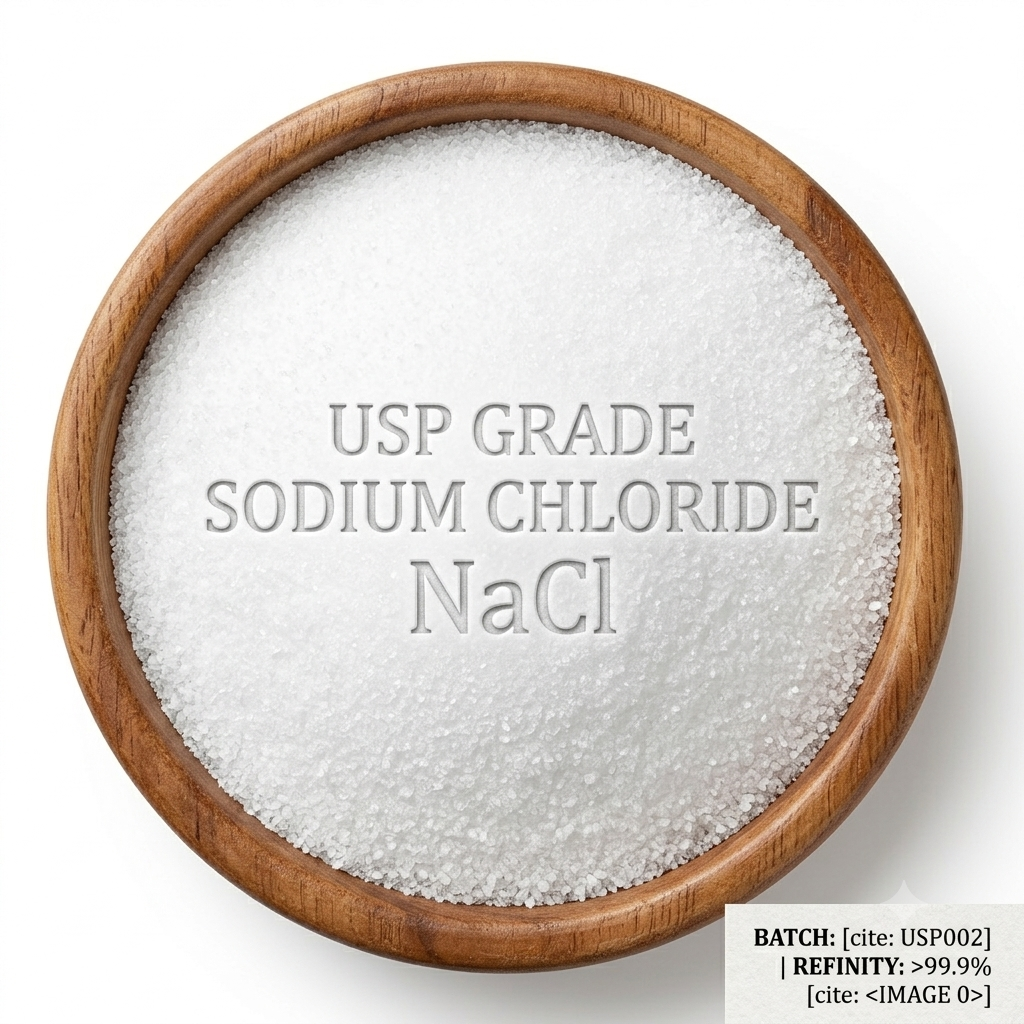
Sterling Analytical provides USP salt analysis for pharmaceutical-grade sodium chloride and potassium chloride, testing assay purity, elemental impurities, and the cross-contamination checks that USP monographs for these two materials specifically build in. Our ICP-OES testing supports manufacturers, compounders, and quality teams working with NaCl and KCl as APIs, excipients, and components of parenteral solutions, where these salts are used in everything from IV fluids and dialysis solutions to oral electrolyte products and as tableting excipients.
Sodium chloride and potassium chloride seem like simple materials — both are common, well-characterized, single-compound salts — but pharmaceutical-grade USP material carries a specific, detailed monograph specification that goes well beyond confirming the salt is mostly NaCl or KCl. Assay purity, related-substance limits, and elemental impurity content under USP <232>/<233> all factor into whether a given batch actually meets USP grade, and the monographs for these two salts specifically include a check that’s easy to overlook: testing each salt for trace contamination by the other.
A Distinctive Feature of These Two Monographs: Testing Each Salt for the Other
This is worth understanding specifically, because it’s a genuinely distinctive aspect of NaCl and KCl testing that doesn’t have an obvious equivalent for most other pharmaceutical salts, and it reflects something real about how these two materials are actually produced.
Sodium chloride and potassium chloride are chemically similar alkali metal halides, often sourced from related mineral deposits or produced through related industrial processes, which creates a real, practical risk of cross-contamination between the two during sourcing or manufacturing. The USP Sodium Chloride monograph specifically includes a limit of potassium test, while the USP Potassium Chloride monograph includes a corresponding sodium check (historically performed by flame test, looking for the characteristic yellow sodium flame color, though instrumental methods can serve the same verification purpose with greater precision and lower detection limits). This isn’t a generic impurity check pulled from a standard panel — it’s a monograph requirement built specifically around the realistic ways these two materials can end up contaminating each other.
This matters practically for testing strategy: a complete NaCl or KCl release testing program should include verification of the other alkali metal specifically, not just a generic trace metals scan that happens to include sodium and potassium somewhere in a broader panel. ICP-OES is well suited to this specific cross-contamination check, since it can quantify both sodium and potassium accurately and simultaneously alongside the rest of the elemental impurity panel, in a single analytical run rather than requiring separate, salt-specific test methods the way older compendial methods did.
From Colorimetric and Flame Tests to Instrumental Methods
The cross-contamination checks built into these monographs have themselves evolved alongside the broader shift in pharmaceutical elemental testing, and understanding this evolution helps explain why a modern ICP-OES-based approach is genuinely an upgrade, not just a different way of getting the same answer.
Older compendial test methods for limit of potassium and similar trace alkali metal checks relied on techniques like flame photometry or atomic absorption spectroscopy referenced through specific USP general chapters — workable, but limited to one element at a time, and requiring separate test setups for each analyte. As USP has revised and harmonized monographs like Sodium Chloride over successive editions (a process formally tracked through the Pharmacopeial Discussion Group’s harmonization stages), references to older single-element general chapters have been updated, and the broader transition away from non-specific or single-element legacy methods mirrors the same shift that replaced USP <231> heavy metals testing with the modern <232>/<233> framework discussed in more detail on our Pharmaceutical Heavy Metals Testing page.
Sodium chloride is typically specified in the range of 99.0–100.5% NaCl (calculated on the dried basis), with potassium chloride specified in a similarly tight range, commonly around 99.0–100.5% or 99.0–101.0% KCl depending on the specific monograph version and any additional customer-specific tightening. Both salts are also subject to a loss-on-drying limit (commonly around 0.5–1.0%), since residual moisture affects both assay calculation and the practical handling and stability of the material.
Assay and Purity Specification
USP-grade sodium chloride and potassium chloride are both held to tight assay purity ranges on a dried basis, reflecting their use in applications — particularly parenteral solutions — where precise, predictable salt concentration genuinely matters for patient safety, not just product quality in the abstract.
USP-grade sodium chloride and potassium chloride are both held to tight assay purity ranges on a dried basis, reflecting their use in applications — particularly parenteral solutions — where precise, predictable salt concentration genuinely matters for patient safety, not just product quality in the abstract.
While ICP-OES doesn’t perform the assay titration itself (that’s typically a separate analytical procedure, often argentometric titration for chloride content), our elemental impurity testing provides the complementary data — confirming what else is present alongside the primary NaCl or KCl content — that a complete release testing package requires.
Matrix & Digestion
Sodium chloride and potassium chloride are both highly soluble salts, making sample preparation comparatively straightforward relative to many of the organic or mineral matrices covered elsewhere on this site — but straightforward doesn’t mean automatic, and a few considerations are still worth getting right.
Our approach:
- Dissolution in dilute acid or water as appropriate to the specific element panel and required sensitivity
- Clean handling protocols appropriate to the low-level impurity targets these monographs specify, since contamination introduced during sample preparation can meaningfully affect results at the ppm levels relevant to USP specifications
- Matrix-matched calibration accounting for the high salt concentration in solution, since — similar in principle to the lithium chloride and brine testing covered elsewhere on this site — a high background salt concentration can affect instrument response for trace elements if not properly accounted for
What We Test For
- Sodium (Na) — for KCl testing : Cross-contamination check specific to the KCl monograph.
- Potassium (K) — for NaCl testing : Cross-contamination check specific to the NaCl monograph.
- Calcium, Magnesium (as Ca) :Alkaline earth metal impurity, commonly limited to a low percentage.
- Heavy metals (as Pb) : Class 1 element screen, commonly limited to low ppm.
- Arsenic (As) : Class 1 element, USP/ICH Q3D relevant.
- Iron (Fe) : Common trace impurity, process-relevant.
- Barium (Ba) : Trace impurity, generally required to pass a qualitative or low-quantitative limit.
- Aluminum (Al) : Trace impurity, relevant particularly for parenteral-grade material
Additional elements relevant to your specific monograph version, customer specification, or intended use (oral, topical, or parenteral) can be added to the panel.
Why Route of Use Changes What "Pharmaceutical Grade" Actually Requires
Not all USP-grade NaCl or KCl is held to the same practical scrutiny, and understanding why helps explain why we ask about intended use when scoping a testing program.
Material destined for parenteral use — large-volume IV fluids, dialysis concentrates, or injectable formulations — faces materially tighter practical expectations than material destined for oral or topical use, even when both nominally meet the same base USP monograph. This is a direct consequence of the ICH Q3D framework covered in more detail on our Pharmaceutical Heavy Metals Testing page: permitted daily exposure limits for elemental impurities are route-dependent, and parenteral routes generally carry meaningfully tighter limits than oral routes for the same element, sometimes by an order of magnitude or more. A trace element level that’s entirely unremarkable in an oral electrolyte tablet could be a genuine concern in an IV fluid formulation using the same nominal grade of salt as a starting material.
This is part of why we recommend specifying intended route of use when scoping NaCl or KCl testing — the underlying chemistry being tested doesn’t change, but what counts as an acceptable result very much does.
Common Quality Issues We Identify
- Cross-contamination between sodium and potassium beyond monograph limits, often tied to shared sourcing or processing with the other alkali salt
- Calcium/magnesium content elevated relative to specification, commonly tied to the original mineral or brine source
- Heavy metal or arsenic levels requiring closer scrutiny for parenteral-intended material specifically
- Iron content relevant to both specification compliance and, in some applications, product appearance or stability
- Inconsistency between supplier certificate of analysis and independently verified results, relevant for incoming QC verification
Who Uses This Service
- Parenteral solution manufacturersverifying NaCl and KCl raw material quality before formulation into IV fluids, dialysis solutions, or injectable products, where elemental impurity limits are at their tightest.
- Oral and topical product manufacturers confirming USP-grade salt meets specification for electrolyte tablets, oral rehydration products, and topical formulations, where route-appropriate limits apply.
- Compounding pharmacies verifying incoming raw material quality, particularly relevant given the direct patient-facing nature of compounded preparations.
- Quality control and incoming inspection teamsconducting routine release testing or supplier verification on NaCl and KCl lots, including the cross-contamination check specific to these two monographs.
- Excipient and raw material suppliers providing independent, third-party verified analytical data to pharmaceutical manufacturer customers as part of supplier qualification documentation.
Sample Quantity & Handling
Required sample size: 1–5 grams of representative material.
Packaging guidelines:
- Use clean, sealed HDPE or polypropylene containers; avoid glass given the low-level trace impurity targets involved and glass's potential to leach trace elements
- Ensure the sample is representative and well-mixed, particularly for material sourced from large bulk lots
- Clearly label material (NaCl or KCl specifically), intended use/route of administration, and any specific monograph version or customer specification relevant to your application
Turnaround Time & Pricing
Standard turnaround: 3–5 business days Rush service: 24–48 hours available
Pricing starts from $150 per sample, depending on element panel and whether parenteral-grade sensitivity (potentially requiring ICP-MS) is required.
What You Receive
Clients receive a Certificate of Analysis suitable for release testing, supplier qualification, and regulatory documentation.
Your COA includes:
- Cross-contamination check (Na in KCl, or K in NaCl as applicable)
- Full elemental impurity panel relevant to USP specification
- Method references and preparation notes
- Reporting limits and analytical qualifiers
- Batch-level quality control summary
All results are supported by CRM-traceable calibration, with duplicates and matrix spikes performed on each analytical batch.
Methods & Standards
Sterling Analytical applies methods aligned with current USP and ICH Q3D pharmaceutical standards:
- ICP-OES elemental analysis suited to NaCl/KCl matrix
- ICP-MS available where parenteral-grade ultra-trace sensitivity is required
- Testing scoped to current USP / elemental impurity framework, replacing legacy USP methodology
- Calibration using certified reference materials (CRMs)
Related Services
Explore related services:
- Pharmaceutical Heavy Metals Testing
- Residual Palladium In API Testing
- Supplement & Nutritional Heavy Metals Testing
- Battery Grade Lithium Chloride Testing
- Trace metal contamination analysis
Request a Quote
Submit your sample details, intended use, and any specific monograph or customer specification to receive a tailored quote and recommended testing scope.
Frequently Asked Questions
It's testing of pharmaceutical-grade sodium chloride and potassium chloride against USP monograph specifications, including elemental impurity content and the cross-contamination check between the two related alkali metal salts.
Sodium chloride and potassium chloride are chemically similar alkali metal halides often sourced from related mineral or brine deposits, creating real cross-contamination risk during sourcing or processing. Each monograph includes a specific limit test for the other element to address this realistic contamination pathway.
Not necessarily for practical purposes. While both may meet the same base USP monograph, parenteral products are subject to meaningfully tighter elemental impurity limits under ICH Q3D's route-dependent framework, so material intended for injectable use generally warrants closer scrutiny than oral or topical use.
No. The primary assay (typically argentometric titration for chloride content) is a separate analytical procedure. ICP-OES testing provides the complementary elemental impurity and cross-contamination data that completes a full release testing package.
1–5 grams of representative material.
Standard turnaround is 3–5 business days, with 24–48 hour rush service available.
Yes, in practical terms. Older methods like flame photometry test one element at a time and require separate setups per analyte. ICP-OES quantifies sodium, potassium, calcium, magnesium, iron, and other relevant elements simultaneously from a single preparation, reducing handling steps that each introduce contamination risk at the low-ppm levels these specifications target.
Yes. We can scope a panel covering Class 1 elements (arsenic, lead), calcium/magnesium, iron, barium, and additional elements relevant to your specific monograph version or customer specification.
Quick Contact
If you have any questions or need help, feel free to contact with our team.
Send Us Email:
Call Us Today: