Phone:
(413) 214-6541
Location:
15 Agawam Ave West Springfield, MA 01089
Mon - Fri:
8.00am - 7.00pm
Parent Website:
sterlinganalytical.com
- Home
- About Us
- Tests & Services
Precious Metals & Catalyst Analysis
- Precious Metal Assay Lab
- Platinum Group Metal (PGM) Analysis
- Rhodium & Iridium Assay Testing
- Gold, Platinum & Palladium Ore Assay
- Catalyst Impurity Testing
- Spent Catalyst Precious Metal Recovery Assay
- Spent Catalyst Analysis
- FCC Catalyst Analysis / E-Cat Metals Testing
- Pd/C Catalyst Metal Loading Testing
- Platinum Reforming Catalyst Testing
- Catalyst Poisoning & Contamination Testing
- Catalyst Support & Adsorbent Testing
Mining, Concentrates, Rare Earths & Critical Minerals Testing
- Copper Concentrate Assay
- Bauxite & Alumina Analysis
- Rare Earth Concentrate & Total REE Analysis
- Nickel & Cobalt Concentrate Assay
- Zinc & Lead Concentrate Analysis
- Iron Ore & Manganese Ore Analysis
- Tungsten Ore & Concentrate Assay
- Antimony Ore & Concentrate Assay
- Magnesite Ore & Concentrate Assay
- Mineral Sample ICP Analysis
- Contact Us
- Sample Delivery Instructions
Rare Earth Concentrate & Total REE Analysis
Related Posts
Sterling Analytical provides rare earth concentrate analysis, quantifying individual rare earth elements (REEs) and total rare earth oxide (REO) content in bastnasite, monazite, xenotime, and ion-adsorption clay-derived concentrates. Our ICP-MS testing serves rare earth mining operators, processors, and downstream buyers who need accurate individual-element data — not just a total REE number — because in this industry, which specific elements are present often matters more commercially than how much total rare earth content a concentrate carries.
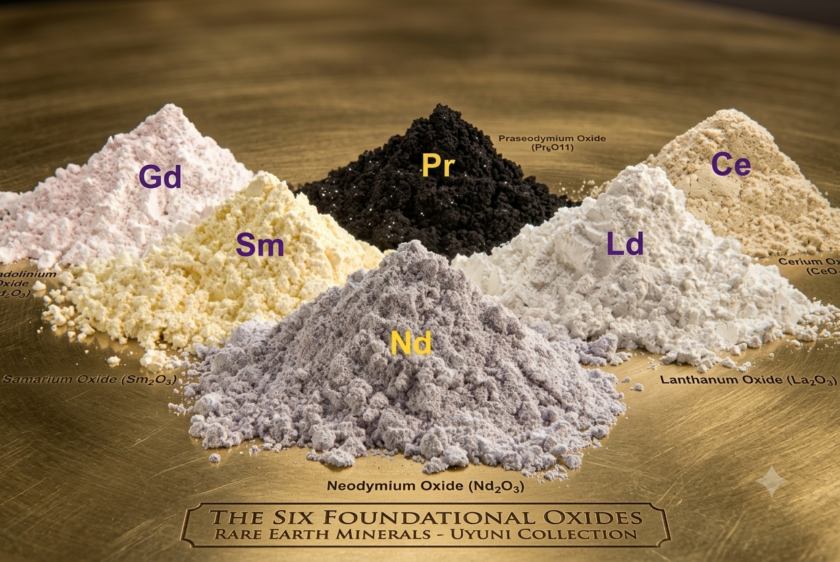
Rare earth elements are genuinely not rare in absolute terms; what makes them difficult and valuable is that they’re geochemically similar enough to almost always occur together, dispersed, and resistant to economical separation. A rare earth concentrate’s value depends heavily on its specific elemental distribution — the balance between light rare earth elements (LREEs: lanthanum through samarium) and heavy rare earth elements (HREEs: europium through lutetium, plus yttrium) — since heavy REEs are generally scarcer and command significantly higher value than light REEs, even though “total REO” doesn’t distinguish between them on its own.
Why "Total REE" Isn't the Number That Actually Matters Most
This is worth stating directly, because it’s the single most important thing to understand about rare earth concentrate value, and a total REO percentage alone doesn’t capture it.
Light rare earth elements — particularly cerium and lanthanum — make up the large majority of most commercial rare earth deposits, commonly 90% or more of total rare earth content in bastnasite and monazite sources. These elements are useful, but relatively abundant and lower-value compared to several heavy rare earth elements like dysprosium, terbium, and yttrium, which are essential for high-performance magnets and other advanced applications but occur in far smaller quantities in most deposits. A concentrate reporting an impressive total REO grade built almost entirely on cerium and lanthanum is a fundamentally different commercial proposition than a smaller total REO figure carrying a meaningfully higher proportion of heavy REEs — which is exactly why individual element quantification, not just a total figure, is what buyers and processors actually need to value a concentrate accurately.
Matrix & Digestion
Rare earth minerals present genuine analytical challenges distinct from most other concentrate types covered on this site, requiring both careful sample preparation and careful instrument method design to get individual REE results right.
Sterling Analytical’s approach:
- Fusion-based or strong acid digestion suited to the specific mineral matrix (bastnasite, monazite, xenotime, or clay-hosted material each behave differently)
- ICP-MS analysis with method design specifically accounting for spectral interferences that are characteristic of REE analysis — light REE oxide species can overlap directly with heavy REE masses (for example, light REE oxide ions forming at masses that interfere with gadolinium or lutetium signals), which means accurate heavy REE quantification specifically requires interference correction or chemical separation, not just running a standard multi-element method
- Separation or correction approaches matched to which specific elements matter most for your application, since correcting for every possible interference isn't always necessary if your primary interest is total LREE content rather than ultra-trace HREE precision
What We Test For
- Light REE (LREE) : Lanthanum (La), Cerium (Ce), Praseodymium (Pr), Neodymium (Nd), Samarium (Sm).
- Heavy REE (HREE) : Europium (Eu), Gadolinium (Gd), Terbium (Tb), Dysprosium (Dy), Holmium (Ho), Erbium (Er), Thulium (Tm), Ytterbium (Yb), Lutetium (Lu), Yttrium (Y).
- Radioactive/regulated elements : Thorium (Th), Uranium (U).
- Process-relevant elements : Iron (Fe), Aluminum (Al), Calcium (Ca), Phosphorus (P).
Individual REE results are reported alongside calculated total REO, LREE/HREE ratio, and critical-element-specific figures (such as combined Nd-Pr or Dy-Tb content) where relevant to magnet-material applications.
Why Thorium and Uranium Screening Is Essential, Not Optional, for This Material
This is a genuinely distinctive consideration for rare earth concentrate that most other materials on this site don’t share: REE deposits routinely contain naturally occurring radioactive material (NORM), specifically thorium and uranium, due to their tendency to substitute into the same mineral lattices as rare earth elements.
The degree of radioactivity varies enormously by mineral source. Monazite is the most thorium-rich common REE mineral, typically carrying 5–12% thorium dioxide, which is part of why bastnasite displaced monazite as the dominant commercial REE source decades ago — bastnasite carries comparatively little thorium and avoids much of the regulatory and handling complexity monazite requires. Even deposits considered relatively “clean” still generate meaningful absolute thorium volumes at scale: published figures for one major operating rare earth mine describe an ore body running only about 0.02% thorium by weight, yet because of the volume processed, this still works out to roughly 2.6 kilograms of thorium generated for every ton of rare earth produced.
This matters directly for testing and project planning: thorium and uranium results aren’t an afterthought on a rare earth concentrate assay, they’re a core determinant of processing route, regulatory classification, waste handling requirements, and overall project economics. A concentrate with attractive REE content but unexpectedly high thorium can face meaningfully different — and more expensive — downstream handling requirements than one with a similar REE profile but low radioactivity, which is exactly the kind of distinction an accurate assay surfaces early rather than after a processing or shipping decision has already been made.
Mineral Source Matters for What to Expect
Understanding which mineral is the dominant REE host in a given concentrate helps frame what results to expect and what processing considerations apply:
- Bastnasite : is a fluorocarbonate mineral carrying roughly 65–75% REO by weight, among the richest REE-bearing minerals commercially exploited, strongly enriched in light REEs, and comparatively low in thorium — properties that have made it the dominant global source of commercial REE production.
- Monazite: is a phosphate mineral with a broadly similar light-REE-dominant distribution to bastnasite, but with substantially higher thorium content (5–12% ThO2), requiring dedicated thorium removal as a distinct processing step and additional regulatory consideration..
- Xenotime: is a phosphate mineral similar to monazite but specifically enriched in heavy REEs and yttrium, making it commercially significant despite contributing a small fraction of total global REE production, precisely because of its heavy REE concentration.
- Ion-adsorption clays : an important and distinct REE source particularly relevant in parts of Asia, tend to carry a more favorable heavy REE distribution than typical hard-rock sources, which is part of why this resource type has drawn significant commercial interest despite generally lower total REO grades than bastnasite or monazite.
Who Uses This Service
- Rare earth mining and processing operators characterizing concentrate composition for both technical processing decisions and commercial valuation, where individual REE distribution drives value far more than total REO alone.
- Downstream REE buyers and magnet material producers screening incoming concentrate or intermediate material against required individual-element specifications, particularly for critical elements like neodymium, praseodymium, dysprosium, and terbium.
- Project developers and junior mining companies characterizing exploration or pilot-scale samples, where accurate individual REE and thorium/uranium data is essential for both resource economics and regulatory permitting planning.
- Process engineers evaluating separation circuit performance, using individual element recovery and distribution data to assess and optimize solvent extraction or other separation processes.
- Environmental and regulatory compliance teams requiring defensible thorium and uranium data to support NORM handling, waste classification, and regulatory reporting obligations tied to REE processing operations.
Sample Quantity & Handling
Required sample size: 20–50 grams of representative concentrate or ore material.
Packaging guidelines:
- Use sealed, clean containers appropriate for mineral concentrate material
- Ensure the sample is genuinely representative — REE distribution can vary across a deposit or processing stream more than total grade alone would suggest
- Clearly label mineral source (bastnasite, monazite, xenotime, ion-adsorption clay, or mixed) where known, since this materially affects the analytical approach and interpretation context we apply
Turnaround Time & Pricing
Standard turnaround: 5–7 business days, reflecting the additional method complexity of accurate individual REE quantification Rush service available on request
Pricing starts from $200 per sample, depending on element panel scope and whether full individual REE quantification versus total REO screening is required.
What You Receive
Clients receive a detailed Certificate of Analysis (COA) suitable for technical evaluation, commercial valuation, and regulatory documentation.
Your COA includes:
- Individual REE concentrations (LREE and HREE) plus calculated total REO
- Thorium and uranium content
- Process-relevant element panel (Fe, Al, Ca, P)
- Method references and digestion notes
- Reporting limits and analytical qualifiers
- Batch-level quality control summary
All results are supported by CRM-traceable calibration, with duplicates and matrix spikes performed on each analytical batch — important given how directly individual REE results feed into both commercial valuation and regulatory classification.
Methods & Standards
Sterling Analytical applies established methods adapted for rare earth concentrate materials:
- Fusion-based or strong acid digestion suited to specific REE mineral matrices
- Calibration using certified reference materials (CRMs) specific to REE analysis
- ICP-MS analysis with interference correction appropriate to individual REE quantification
Related Services
Explore related services:
- Spodumene Concentrate Testing
- Iron Ore & Manganese Ore Analysis
- Iron Ore & Manganese Ore Analysis
- Nickel & Cobalt Concentrate Assay
- Catalyst Impurity Testing
Request a Quote
Ready to get started with rare earth concentrate analysis?
Submit your sample details, including known or suspected mineral source, to receive a fast quote and recommended analytical scope.
Frequently Asked Questions
It's used to quantify individual rare earth elements and total REO content in bastnasite, monazite, xenotime, and clay-derived concentrates, supporting commercial valuation, processing decisions, and regulatory compliance.
Light rare earth elements like cerium and lanthanum dominate most deposits by volume but carry lower value than scarcer heavy REEs like dysprosium and terbium, which are essential for high-performance applications. A high total REO figure built mostly on light REEs is commercially very different from a lower total figure with more heavy REE content.
REE deposits routinely contain naturally occurring radioactive thorium and uranium due to lattice substitution in the host minerals. Thorium content varies enormously by mineral source (monazite can carry 5-12% ThO2, while bastnasite carries comparatively little) and directly affects processing route, regulatory classification, and waste handling requirements.
Bastnasite and monazite are both light-REE-dominant minerals, but monazite carries substantially more thorium. Xenotime is enriched in heavy REEs and yttrium instead, making it commercially significant despite contributing a small share of global production.
Light REE oxide ions can form at masses that overlap with heavy REE signals, requiring interference correction or chemical separation for accurate heavy REE quantification, particularly at trace concentrations.
Not necessarily. A deposit can carry a very low thorium percentage by weight and still generate a meaningful absolute volume of thorium at scale, given the total tonnage processed. Percentage content and total regulatory/handling burden are related but distinct questions worth evaluating separately.
The same individual-REE ICP-MS approach applies, but ion-adsorption clay often requires different digestion considerations than bastnasite or monazite given its distinct mineralogy, and typically shows a more favorable heavy REE distribution worth highlighting in interpretation.
Standard turnaround is 5–7 business days, reflecting the additional method complexity involved in accurate individual REE quantification. Rush service is available on request.
Quick Contact
If you have any questions or need help, feel free to contact with our team.
Send Us Email:
Call Us Today: