Battery Materials Testing
Phone:
(413) 214-6541
Location:
15 Agawam Ave West Springfield, MA 01089
Mon - Fri:
8.00am - 7.00pm
Parent Website:
sterlinganalytical.com

- Home
- About Us
- Tests & Services
Catalyst Analysis Services
- Catalyst Impurity Testing
- Spent Catalyst Analysis
- Spent Catalyst Precious Metal Recovery Assay
- Precious Metal Assay Lab
- FCC Catalyst Analysis / E-Cat Metals Testing
- Pd/C Catalyst Metal Loading Testing
- Platinum Reforming Catalyst Testing
- Catalyst Poisoning & Contamination Testing
- Catalyst Support & Adsorbent Testing
- Contact Us
- Sample Delivery Instructions
Black Mass Analysis: Unlocking Critical Metals from Battery Recycling Streams
Related Posts
Sterling Analytical provides advanced black mass analysis, combining high-precision ICP-OES elemental testing with digestion chemistry built specifically for the demands of lithium-ion battery recycling materials. In a rapidly growing recycling industry, black mass isn’t just a byproduct of battery shredding — it’s a concentrated, high-value resource stream carrying critical minerals like lithium, cobalt, nickel, and manganese that directly determine recovery economics and feed valuation.
Our laboratory supports battery black mass testing and lithium battery recycling analysis with precise, defensible data across a wide range of chemistries and feedstocks. Whether you’re evaluating incoming material before purchase, optimizing hydrometallurgical recovery, or validating refining performance downstream, accurate black mass composition analysis is the foundation every one of those decisions sits on.
By fully dissolving complex battery materials and quantifying lithium, cobalt, nickel, manganese, and the elements around them, we generate data that supports recovery optimization, feedstock valuation, and refining efficiency in equal measure. Our methods are built to handle mixed chemistries from NMC, NCA, and LFP batteries, holding up even in the carbon-rich, metal-oxide-heavy matrices that make black mass one of the more demanding materials to digest cleanly.
If you’re searching for a black mass analysis laboratory for battery recycling materials, Sterling Analytical delivers precise, defensible results with rapid turnaround.
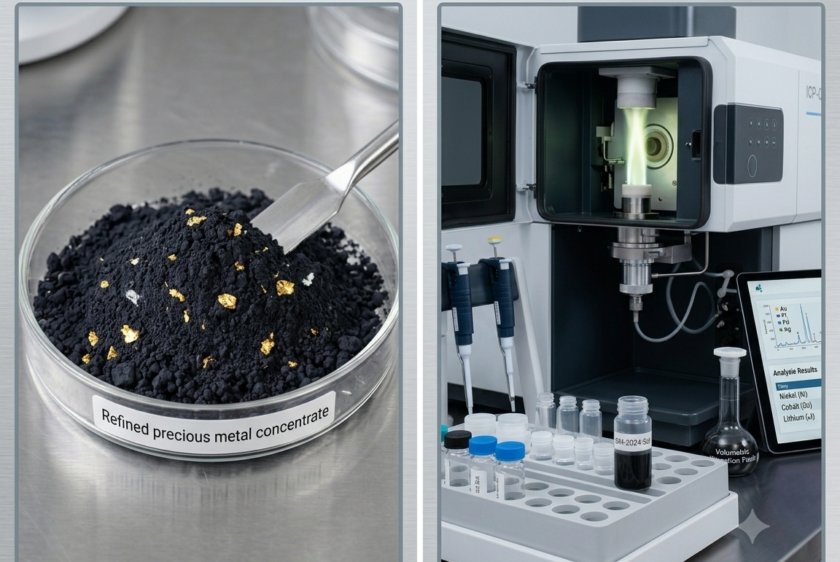
Matrix & Digestion
Black mass composition analysis requires complete dissolution of a genuinely heterogeneous mixture — cathode materials, graphite, conductive carbon, binders, and metallic residues all in the same sample. Incomplete digestion is one of the most common sources of error in battery black mass testing, particularly where refractory oxides and stubborn carbon fractions are present, and it’s the single biggest reason two labs can report different numbers on what should be the same material.
Sterling Analytical uses microwave-assisted acid digestion aligned with EPA 3052 principles, tailored specifically for lithium battery recycling analysis:
- Nitric acid (HNO3) and hydrochloric acid (HCl) for base metal dissolution
- Hydrofluoric acid (HF) for breaking down silicate phases and refractory oxides
- Hydrogen peroxide (H2O2) to oxidize residual organics and carbonaceous material
- Boric acid complexation post-digestion to neutralize HF and stabilize the solution for ICP-OES
Closed-vessel microwave digestion ensures complete dissolution of lithium cobalt oxides, nickel manganese cobalt (NMC), lithium iron phosphate (LFP), and the aluminum and copper fractions that come along with shredded battery material.
For highly refractory residues, lithium borate fusion may be used as a secondary preparation technique. Where fusion is applied, procedures are controlled specifically to preserve lithium recovery and account for flux-derived matrix effects, since fusion chemistry can introduce its own bias if not handled carefully — ensuring accurate reporting of Li alongside the transition metals that matter most for critical metals analysis.
Elements Reported & Typical Reporting Limits
Our black mass analysis covers both the high-value metals driving recovery economics and the key impurities that affect downstream processing. This critical metals analysis — lithium, cobalt, nickel, manganese, and more — is built to support technical optimization and commercial settlement alike.
- Lithium (Li) : 5
- Cobalt (Co) : 2
- Nickel (Ni) :2
- Manganese (Mn): 2
- Copper (Cu) : 1
- Aluminum (Al) : 5
- Iron (Fe) : 5
- Phosphorus (P) : 10
- Silicon (Si) : 10
- Calcium (Ca) : 5
- Magnesium (Mg) : 2
- Sodium (Na) : 5
- Potassium (K) : 5
- Zinc (Zn) : 2
- Lead (Pb) : 1
Additional elements are available on request depending on your specific recovery workflow and refining requirements.
Why Digestion Chemistry Is the Real Differentiator
It’s worth being direct about why digestion gets this much attention on a black mass page specifically. Black mass isn’t a clean, single-phase material — it’s the end product of shredding entire battery cells, which means a single sample can contain lithium cobalt oxide, NMC particles, graphite, copper and aluminum foil fragments, polymer binder residue, and electrolyte breakdown products, all at once. Each of these components dissolves differently, and a digestion method tuned for one (say, base metal dissolution) can leave another (silicate phases, residual carbon) only partially broken down.
The practical consequence: a black mass result that looks clean and complete can still be quietly underreporting lithium or transition metals if the digestion didn’t fully reach every phase in the sample. This is the most common way two analyses of supposedly identical material end up disagreeing, and it’s why our digestion approach specifically targets each major component class rather than applying a single generic acid digestion across the board.
Common Black Mass Composition Issues We Identify
Across the black mass samples we analyze, certain patterns come up repeatedly:
- Underreported lithium due to incomplete breakdown of lithium-bearing oxide phases
- Inconsistent cobalt and nickel results between suppliers tied to differing digestion practices upstream
- Higher-than-expected copper or aluminum content from incomplete shredding/separation, affecting downstream processing
- Elevated phosphorus or fluorine-adjacent species from electrolyte salt residue
- Mixed-chemistry feedstocks (NMC blended with LFP, for example) producing compositional results that don't match a single expected battery chemistry profile
Identifying which of these is present often matters as much as the headline lithium or cobalt number, particularly when a result is being used to value or negotiate a feedstock lot.
From Composition Data to Commercial Value
Black mass valuation ultimately comes down to contained metal content multiplied by prevailing metal prices, adjusted for expected recovery efficiency in downstream processing — which means the accuracy of the underlying composition data flows directly into the price both sides of a transaction agree on. A black mass lot with 6% lithium versus 5.5% lithium isn’t a rounding difference at scale; across a large lot, that half-percentage-point gap can represent a meaningful swing in contained value.
This is part of why digestion completeness matters commercially, not just analytically. A result that underreports lithium or cobalt because of incomplete digestion doesn’t just produce an inaccurate number — it systematically undervalues the material for whoever is selling it, or conversely, an overreported result can lead a buyer to overpay relative to true recoverable content. Buyers and sellers with access to the same rigorous, defensible methodology are positioned to negotiate from the same factual basis, which is often more valuable to both parties than either side simply trusting the other’s in-house numbers.
For recurring black mass relationships — a recycler regularly selling to the same refiner, for example — consistent, defensible third-party testing also reduces the friction of renegotiating trust on every single lot.
Who Uses This Service
- Battery recyclers characterizing incoming black mass before purchase, using compositional data to set fair pricing against contained metal value.
- Hydrometallurgical recovery operators optimizing leaching and recovery process parameters around the actual composition of the feedstock they're processing, rather than an assumed or nominal composition.
- Refiners and metal traders verifying lot composition before a transaction, where defensible, third-party data protects both sides of a deal.
- Battery manufacturers and OEMs with internal recycling or closed-loop material programs, tracking recovered material composition against virgin material specifications.
- Black mass producers (battery shredders and pre-processors) using compositional testing as ongoing QC across their own production, confirming consistency lot to lot.
Sample Quantity & Packaging
Required sample size: 5–20 grams of representative black mass.
Packaging guidelines:
- Use sealed HDPE or polypropylene containers
- Avoid glass due to HF digestion compatibility
- Ensure the sample is well-mixed and representative
- Clearly label batch ID, chemistry type (NMC, LFP, etc.), and source
Proper sampling is critical for accurate black mass composition analysis, especially when dealing with blended or multi-source recycling streams where composition can vary meaningfully within a single lot.
Turnaround Time & Pricing
Standard turnaround: 3–5 business days Rush service: 24–48 hours available
Black mass analysis pricing starts from $150 per sample, depending on element suite and digestion complexity. Pricing scales for routine battery black mass testing programs and high-volume lithium battery recycling analysis.
What You Receive
Clients receive a detailed Certificate of Analysis (COA) suitable for technical evaluation, process optimization, and commercial settlement of battery recycling materials.
Your COA includes:
- Elemental composition (ppm and wt%) via ICP-OES
- Full black mass composition analysis results across key metals
- Method references and digestion notes
- Reporting limits and analytical qualifiers
- Lot-based quality control summary
All results are supported by CRM-verified calibration, with duplicates and matrix spikes performed on each analytical batch to ensure accuracy and reproducibility — critical for high-value critical metals analysis involving lithium, cobalt, and nickel.
Methods & Standards
Sterling Analytical follows established methods adapted for battery recycling materials:
- EPA 3052 – Microwave-assisted acid digestion
- EPA 3051A – Acid digestion of environmental matrices
- SW-846 6010 – ICP-OES elemental analysis
These methods are adapted specifically for black mass analysis to ensure complete recovery of lithium-ion battery components and accurate critical metals reporting.
Related Services
Explore related services:
You can also explore our broader Battery Materials Testing services for related capabilities across the battery materials supply chain.
Request a Quote
Ready to get started with black mass analysis?
Submit your sample details to receive a fast, no-obligation quote. Our team will confirm pricing, turnaround time, and any specific preparation requirements.
Frequently Asked Questions
Black mass analysis determines the concentration of valuable metals in lithium-ion battery recycling materials, supporting both process optimization and commercial valuation.
Sterling Analytical provides battery black mass testing services for clients across the U.S. and internationally, with fast turnaround and easy sample submission.
Black mass composition analysis includes lithium, cobalt, nickel, manganese, and other key elements required for refining and recovery calculations.
Accurate lithium battery recycling analysis ensures proper valuation of feedstock and helps optimize metal recovery efficiency in downstream processes.
Critical metals analysis refers to the precise measurement of high-value elements such as lithium, cobalt, and nickel, which are essential to battery manufacturing and recycling economics.
The most common cause is digestion method, not instrument disagreement. Black mass contains multiple distinct material phases that dissolve differently, and a digestion approach that doesn't fully break down each one can underreport lithium or transition metals even when the instrument itself is performing correctly.
Yes. Reports are supported by CRM-traceable calibration and quality control data designed to provide defensible, independently generated results.
Yes. Mixed feedstocks combining NMC, NCA, and LFP material are common in recycling streams, and our digestion and reporting approach is built to handle them without requiring chemistry to be pre-sorted.
Quick Contact
If you have any questions or need help, feel free to contact with our team.
Send Us Email:
Call Us Today: