Phone:
(413) 214-6541
Location:
15 Agawam Ave West Springfield, MA 01089
Mon - Fri:
8.00am - 7.00pm
Parent Website:
sterlinganalytical.com

- Home
- About Us
- Tests & Services
Catalyst Analysis Services
- Catalyst Impurity Testing
- Spent Catalyst Analysis
- Spent Catalyst Precious Metal Recovery Assay
- Precious Metal Assay Lab
- FCC Catalyst Analysis / E-Cat Metals Testing
- Pd/C Catalyst Metal Loading Testing
- Platinum Reforming Catalyst Testing
- Catalyst Poisoning & Contamination Testing
- Catalyst Support & Adsorbent Testing
- Contact Us
- Sample Delivery Instructions
Catalyst Poisoning & Contamination Testing
Related Posts
Sterling Analytical provides catalyst poisoning and contamination testing to diagnose why a catalyst is underperforming, not just to confirm what’s on it. Our ICP-OES and ICP-MS testing supports refinery process engineers, catalyst technologists, and plant chemists investigating unexpected activity loss, selectivity shift, or premature deactivation — typically after a unit performance problem has already shown up, rather than as routine QC.
Catalyst poisoning happens when a contaminant species binds strongly to the catalyst’s active sites, blocking access for the reactants the catalyst is supposed to convert. The chemistry behind this isn’t uniform: some poisons distribute evenly across all active sites (uniform poisoning), while others preferentially target one specific type of site (selective poisoning), which can shift selectivity even when overall conversion looks only modestly affected. Some poisoning is reversible — the contaminant is weakly enough bound that removing it from the feed and reactivating the catalyst restores activity — while other poisoning is irreversible, where the poison reacts to form a new, stable compound on the catalyst surface that no amount of regeneration will undo. Knowing which type of poisoning is occurring changes the entire response: a reversible poisoning event might be solved by a feed change and reactivation, while irreversible poisoning usually means the catalyst’s remaining life is the real question on the table.
This is the core difference between this service and routine catalyst impurity testing: impurity testing typically confirms a catalyst meets specification before or during normal use, while poisoning and contamination testing is built around diagnosing an active performance problem — working backward from symptoms (lost activity, shifted selectivity, shortened run length) to the contaminant and mechanism responsible.
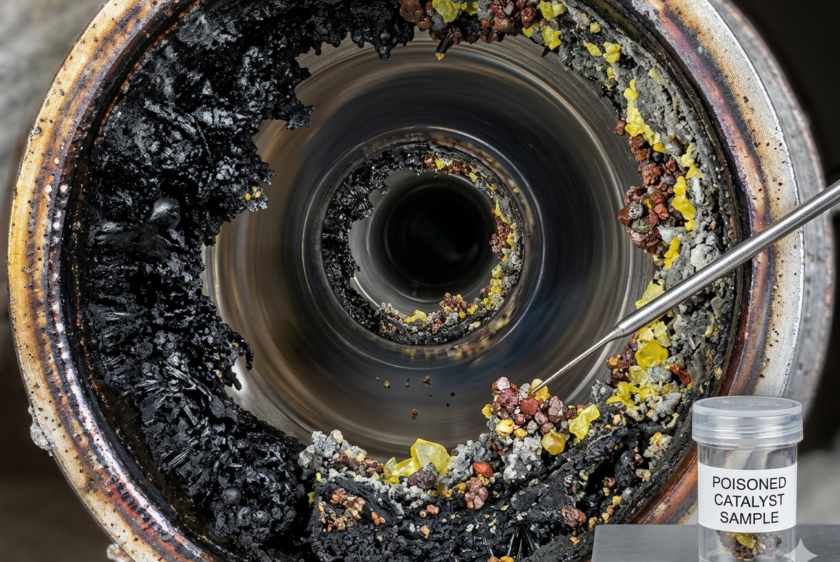
How Catalyst Poisoning Actually Happens
Poisoning isn’t a single phenomenon — it happens through a small number of distinct mechanisms, and which one is at play affects both the diagnosis and what (if anything) can be done about it:
- Chemisorption (the core mechanism): A poison species bonds strongly to an active site, physically occupying space a reactant molecule would otherwise use. This is the defining mechanism of poisoning, as distinct from fouling (physical blockage by deposits like coke) or sintering (loss of active surface area from thermal degradation) — related but mechanistically different deactivation pathways.
- Geometric vs. electronic effects: A poison can act purely geometrically, physically blocking a site, or it can act electronically, altering the catalyst surface's electronic structure in a way that reduces the activity of neighboring sites even without directly occupying them. Some elements — sulfur, chlorine, phosphorus, and nitrogen among them — are known to produce both effects simultaneously on certain catalyst systems, which is part of why they're such effective poisons relative to their concentration.
- Selective vs. uniform poisoning: Some poisons bind equally to every active site (uniform), gradually reducing activity in proportion to poison concentration. Others preferentially target one specific site type (selective), which can produce a disproportionate selectivity shift well before total activity loss becomes obvious — a pattern that's easy to misread as a feed or operating condition issue if the catalyst itself isn't tested.
- Reversible vs. irreversible poisoning: Reversible poisoning involves comparatively weak chemisorption; removing the contaminant from feed and reactivating the catalyst (often with hydrogen or oxidative treatment, depending on the system) can restore activity. Irreversible poisoning involves a poison that reacts to form a new, thermodynamically stable surface compound — sulfate formation from sulfur poisoning is a well-documented example — that doesn't reverse with standard regeneration. Distinguishing the two often requires understanding both the contaminant identified and the catalyst's specific chemistry, not just a positive detection result.
Elements from groups 15 and 16 of the periodic table — phosphorus, arsenic, antimony, bismuth, sulfur, selenium — are particularly effective poisons across many catalyst systems, largely because they carry electron lone pairs that form strong dative bonds with the transition metals commonly used as active catalytic sites. This is part of why these elements anchor most poisoning panels regardless of catalyst type.
What We Test For
Our catalyst poisoning and contamination panel is built around the elements and compounds most commonly responsible for deactivation, customized to your specific catalyst system:
- Classic poisons (Group 15/16): Sulfur, Phosphorus, Arsenic, Antimony, Selenium.
- Halogens: Chlorine, Fluorine
- Alkali / alkaline earth contaminants: Sodium, Potassium, Calcium, Magnesium
- Heavy metal poisons: Lead, Mercury, Bismuth
- Transition metal contaminants: Iron, Nickel, Vanadium, Copper
- Support-structure contaminants: Silicon
Reporting limits depend on catalyst matrix and the sensitivity required — ICP-OES typically covers low-ppm through percent-level results, while ICP-MS extends detection into sub-ppm and ppb territory for trace-poison investigation or pharmaceutical-adjacent specifications.
Diagnostic Approach: Working Backward From Symptoms
Unlike routine QC testing, poisoning and contamination investigations usually start with a known problem and work backward to a cause. The pattern of contamination across a catalyst bed often tells as much of the story as the absolute concentration of any single element:
- Localized vs. distributed contamination : A poison concentrated at the bed inlet, for example, often points to a feed-borne contaminant being captured preferentially near the point of entry, while uniform distribution suggests a different exposure pathway
- Co-occurring contaminants : Some poisoning effects compound when two contaminants are present together; arsenic and potassium co-poisoning of certain catalyst systems, for instance, produces deactivation more severe than either element alone would predict, which is one reason multi-element panels diagnose better than single-element testing
- Surface vs. bulk distribution : a contaminant concentrated at the particle surface versus distributed through the particle can point toward different deposition timelines and mechanisms
- Comparison against fresh catalyst baseline : without a fresh or early-life reference point, it can be difficult to distinguish normal trace contamination from a poisoning event significant enough to explain an observed performance problem
Where useful, we can test samples from multiple bed locations or multiple points in time to help build this kind of diagnostic picture, rather than relying on a single data point to explain a complex deactivation event.
Common Poisoning and Contamination Scenarios We Investigate
- Sulfur or phosphorus poisoning traced to feedstock carryover or upstream process upset
- Sudden activity loss following a feed source or supplier change
- Selectivity shift without a corresponding drop in total conversion, suggestive of selective poisoning
- Premature deactivation inconsistent with normal catalyst age or service history
- Suspected cross-contamination between catalyst batches, reactors, or storage containers
- Heavy metal or halogen contamination traced to corrosion, piping, or upstream equipment
Who Uses This Service
- Refinery and chemical process engineers investigating an unexpected drop in conversion, yield, or selectivity, where catalyst condition is one of several possible root causes under evaluation.
- Catalyst technologists distinguishing reversible from irreversible deactivation to decide between feed correction and reactivation versus catalyst replacement — a decision with significant cost implications either way.
- Plant chemists and QC teams investigating a specific deactivation event tied to a known process upset, feed change, or contamination incident, where the goal is identifying the responsible contaminant rather than routine specification checking.
- Catalyst suppliers and technical service teams supporting customer troubleshooting, using independent third-party data to help confirm or rule out catalyst-side causes for a reported performance issue.
- Insurance and warranty claims investigators establishing root cause when catalyst failure or premature replacement is the subject of a commercial or warranty dispute, where defensible, independently generated data matters.
Sample Quantity & Handling
Required sample size: 5–10 grams of representative catalyst per sample location.
Packaging guidelines:
- Use sealed HDPE or polypropylene containers; avoid glass due to HF digestion compatibility where required
- For diagnostic investigations, submit samples from multiple bed locations (inlet, mid-bed, outlet) where possible, since contamination distribution is often diagnostic in itself
- Include a fresh or early-life catalyst sample as a baseline reference where available — this is often the single most useful addition to a troubleshooting submission
- Clearly label sample location, catalyst age/service history, and a brief description of the performance issue being investigated
The more process context provided — feed changes, recent upsets, observed symptoms — the more useful the resulting interpretation can be, since a contaminant result means more when it can be connected to a plausible exposure event.
Turnaround Time & Pricing
Standard turnaround: 3–5 business days Rush service: 24–48 hours available
Pricing starts from $150 per sample, depending on element panel, digestion complexity, and whether ICP-MS trace-level analysis is required. Multi-location diagnostic submissions are priced per sample, with package pricing available for investigations requiring several locations or time points.
What You Receive
Clients receive a detailed analytical report suitable for root-cause investigation, regeneration/replacement decision-making, and technical or commercial documentation.
Your COA includes:
- Full contaminant element panel (ppm) via ICP-OES/ICP-MS
- Comparison against fresh catalyst baseline where a reference sample is provided
- Distribution analysis across multiple bed locations where applicable
- Method references and digestion notes
- Reporting limits and analytical qualifiers
- Batch-level quality control summary
All results are supported by CRM-traceable calibration, with duplicates and matrix spikes performed on each analytical batch — important when results are feeding into a significant replacement or warranty decision.
Methods & Standards
Sterling Analytical applies established methods adapted for catalyst poisoning and contamination diagnostics:
- EPA 3052 – Microwave-assisted acid digestion
- SW-846 6010 – ICP-OES elemental analysis
- ICP-MS available for sub-ppm trace-poison detection
- Calibration using certified reference materials (CRMs)
Related Services
Explore related services:
Request a Quote
Ready to investigate a catalyst performance issue?
Submit your sample details and a brief description of the issue you’re investigating to receive a fast quote and recommended testing approach.
Frequently Asked Questions
It's used to diagnose the root cause of catalyst underperformance — activity loss, selectivity shift, or premature deactivation — by identifying contaminant elements and the mechanism by which they're affecting the catalyst.
Impurity testing typically confirms a catalyst meets specification during routine QC or incoming inspection. Poisoning and contamination testing is diagnostic, starting from an observed performance problem and working backward to identify the cause.
Reversible poisoning involves weak contaminant binding that can often be reversed by removing the contaminant from feed and reactivating the catalyst. Irreversible poisoning involves a contaminant that reacts to form a stable new compound on the catalyst surface, which standard regeneration cannot undo.
Contamination distribution across a catalyst bed is often diagnostic in itself. Localized contamination near the bed inlet, for example, suggests a different exposure pathway than contamination distributed evenly throughout.
Yes, where available. A fresh or early-life baseline is often the single most useful addition to a diagnostic submission, since it allows contaminant levels to be interpreted against a known reference rather than in isolation.
Yes. Certain contaminant combinations produce compounding deactivation effects beyond what either element would cause individually, which is one reason multi-element panels are more diagnostic than single-element testing.
Standard turnaround is 3–5 business days, with 24–48 hour rush service available.
Yes. Reports are supported by CRM-traceable calibration and quality control data designed to provide defensible, independently generated results.
Quick Contact
If you have any questions or need help, feel free to contact with our team.
Send Us Email:
Call Us Today: