Phone:
(413) 214-6541
Location:
15 Agawam Ave West Springfield, MA 01089
Mon - Fri:
8.00am - 7.00pm
Parent Website:
sterlinganalytical.com
- Home
- About Us
- Tests & Services
Catalyst Analysis Services
- Catalyst Impurity Testing
- Spent Catalyst Analysis
- Spent Catalyst Precious Metal Recovery Assay
- Precious Metal Assay Lab
- FCC Catalyst Analysis / E-Cat Metals Testing
- Pd/C Catalyst Metal Loading Testing
- Platinum Reforming Catalyst Testing
- Catalyst Poisoning & Contamination Testing
- Catalyst Support & Adsorbent Testing
- Contact Us
- Sample Delivery Instructions
Spent Catalyst Analysis for Recovery, Performance, and Valuation
Related Posts
Sterling Analytical provides spent catalyst analysis to determine residual metal content, impurity buildup, and recovery value in deactivated catalyst materials. Using ICP-OES, ICP-MS, and fire assay techniques, we generate accurate, decision-ready data for refiners, recyclers, and catalyst manufacturers handling end-of-life catalyst systems.
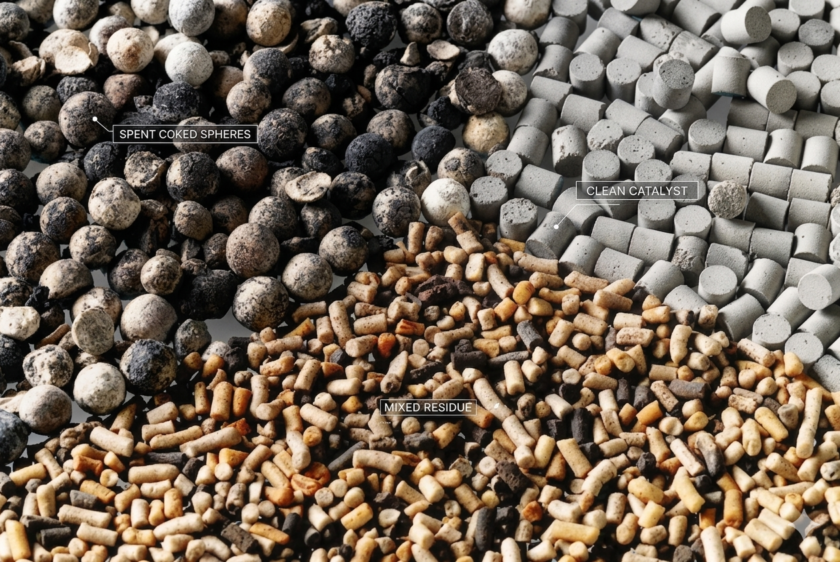
During operation, catalysts lose activity due to poisoning, fouling, and structural changes, while simultaneously accumulating base metals and contaminants from the process stream. Understanding what remains—both in terms of valuable metals and detrimental impurities—is essential for optimizing recovery, evaluating catalyst performance, and supporting commercial settlement.
Spent catalyst analysis is often performed alongside Catalyst Impurity Testing to fully characterize contamination and with Spent Catalyst Precious Metal Recovery to support downstream refining and valuation decisions.
Early, accurate analysis can significantly impact recovery yields, prevent undervaluation, and improve negotiation outcomes with refiners and recyclers.
What Spent Catalyst Analysis Measures
Spent catalyst analysis provides a complete elemental profile across three key areas:
- Residual precious metals (Pt, Pd, Rh, Ru, Au, Ag) for recovery and settlement valuation
- Base metals (Ni, V, Fe, Cu, Zn) affecting refining behavior and processing cost
- Contaminants and poisons (S, P, As, Pb, Si) influencing both catalyst performance and recovery efficiency
We routinely analyze multi-element compositions across complex catalyst matrices, ensuring both technical and financial decisions are based on accurate total metal content.
Matrix & Digestion
Spent catalysts present complex analytical challenges due to:
- Carbon (coke) deposition and fouling
- Sintered or chemically altered metal phases
- Strongly bound contaminants and poisons.
- Refractory supports such as alumina, silica, and zeolites
To ensure complete metal recovery during analysis, Sterling Analytical uses matrix-matched digestion techniques:
- Microwave-assisted acid digestion (EPA 3052) for general catalyst systems
- Hydrofluoric acid (HF) digestion for silica- and alumina-based supports.
- Oxidative digestion for carbon-rich or coked catalysts
- Fusion techniques for highly refractory matrices
Incomplete digestion is one of the most common causes of underreported metal values in spent catalyst analysis. Our methods are designed to fully dissolve both support and metal phases, ensuring accurate total metal accounting.
Analytical Methods
We select analytical techniques based on catalyst composition, required detection limits, and commercial use of the data.
ICP-OES (Inductively Coupled Plasma – Optical Emission Spectroscopy)
Used for multi-element analysis from ppm to percent levels. Ideal for base metals and bulk composition profiling.
ICP-MS (Inductively Coupled Plasma – Mass Spectrometry)
Used for trace and ultra-trace elements, including catalyst poisons and low-level residual metals. Particularly useful where sub-ppm detection is required.
Fire Assay (Lead or Nickel Sulfide Collection)
The preferred method for high-accuracy precious metal determination, especially for platinum group metals in complex or low-concentration matrices. Commonly used for settlement and recovery valuation.
For ultra-trace impurity profiling or contamination diagnostics, see Catalyst Impurity Testing.
When to Use Spent Catalyst Analysis vs. Impurity Testing
While closely related, these services answer different questions:
- Spent Catalyst Analysis focuses on total metal content and recovery value.
- Catalyst Impurity Testing focuses on contamination and poisoning elements
In many cases, both are performed together to fully understand catalyst condition, performance loss, and recovery potential.
Common Use Cases
Spent catalyst analysis is used for:
- Precious metal recovery and recycling valuation.
- Commercial settlement with refiners and buyers
- Catalyst performance and deactivation studies.
- Fresh vs. spent vs. regenerated catalyst comparison.
- Process optimization and loss tracking
Sample Quantity & Handling
Recommended sample size: 10–50 grams depending on heterogeneity and analysis scope.
Accepted forms: pellets, powders, extrudates, beads.
Guidelines:
- Submit a well-mixed, representative sample
- Avoid contamination during sampling and storage
- Use sealed HDPE or polypropylene containers
- Provide catalyst type, process history, and expected metals if known
Highly heterogeneous spent catalysts benefit from larger sample sizes to improve representativeness and analytical confidence.
Turnaround Time & Pricing
Standard turnaround: 3–5 business days
Rush service: 24–48 hours available
Pricing depends on method selection (ICP vs. fire assay), element panel, and sample complexity. Volume pricing is available for routine or bulk submissions.
What You Receive
Each project includes a detailed Certificate of Analysis (COA) suitable for technical, operational, and commercial use.
Your report includes:
- Precious metal content (ppm, wt%, or g/ton)
- Base metal and impurity profile
- Analytical methods used (ICP-OES, ICP-MS, fire assay)
- Reporting limits and qualifiers
- QA/QC summary (duplicates, spikes, standards)
All results are supported by CRM-traceable calibration, ensuring defensible data for recovery valuation and process decisions.
Methods & Standards
- EPA 3052 – Microwave-assisted acid digestion
- SW-846 6010 – ICP-OES elemental analysis
- ICP-MS for trace and ultra-trace element detection
- Fire assay for precious metal quantification
- Certified reference materials (CRMs) for calibration
Related Services
- Catalyst Impurity Testing
- Spent Catalyst Precious Metal Recovery
- Catalyst Poisoning & Contamination Testing
Request a Quote
Ready to analyze your spent catalyst?
Submit your sample details and intended use (recovery, performance evaluation, or settlement). Our team will recommend the appropriate method and provide a fast, no-obligation quote.
Frequently Asked Questions
Spent catalyst analysis is used to determine metal content and composition for recycling, recovery valuation, and process optimization. It helps refineries, recyclers, and traders understand the economic value of catalyst material.
Nickel, vanadium, molybdenum, and cobalt are the most commonly recovered metals. The exact profile depends on the catalyst type and process history.
We use digestion approaches designed to access both surface-bound and embedded metals, including those associated with refractory supports and carbon deposits. This minimizes underreporting and improves accuracy for recovery evaluation.
Spent catalysts often contain metals locked in alumina, silica, or sulfide phases. Without proper digestion, these metals may not be fully measured, leading to inaccurate results.
Yes. Mixed or secondary catalyst streams can be analyzed, though additional preparation may be required to ensure representative and reliable results.
Typically 5–20 grams of well-mixed, representative material is sufficient for analysis.
Standard turnaround is 3–5 business days. Expedited options (24–48 hours) are available if needed.
Quick Contact
If you have any questions or need help, feel free to contact with our team.
Send Us Email:
Call Us Today: